HEA Pushes Universities to Solve Southern Province’s Drought and Food Challenges, with the Director-General Making Case for Locally Relevant Higher Education
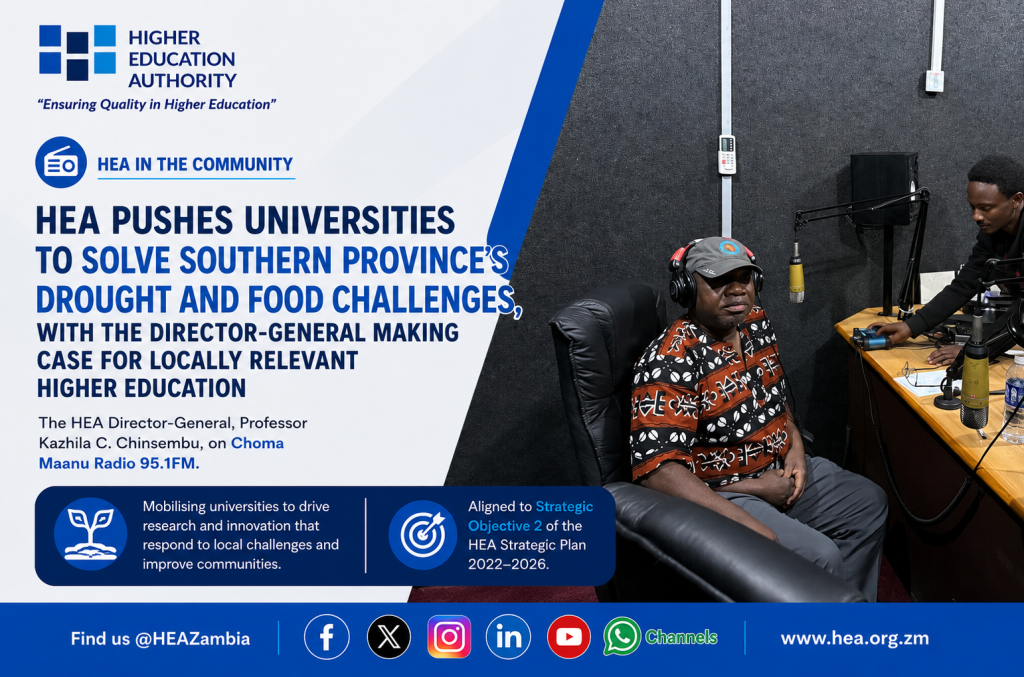
The Director-General of the Higher Education Authority (HEA), Professor Kazhila C. Chinsembu, has challenged higher education institutions in Southern Province to stop operating in isolation from the communities around them and to redirect their research and training toward solving the province’s most pressing problems, including drought, food insecurity, water scarcity and lack of affordable building materials.
Speaking during a live one-hour interview on Choma Maanu Radio Station 95.1FM, on Friday, 22nd May, 2026, Professor Chinsembu said relevance is not optional for colleges and universities, it is a responsibility.
“If we have a college here in Choma, that college must address the challenges that the people in Choma are facing,” he said.
The remarks were made as part of the Director-General’s ongoing stakeholder engagement across the country, conducted under Strategic Objective No. 2 of HEA’s Strategic Plan 2022–2026. For the Authority, these engagements are about accountability through ensuring that Higher Education Institutions (HEIs) understand what is expected of them not just in terms of regulatory compliance, but in terms of their contribution to the societies that host them.
In Southern Province, Professor Chinsembu said, the realities of lower rainfall and recurring drought make it essential that HEI prioritise research into drought-resistant crop varieties, including sorghum, maize and millet, as well as livestock breeding adapted to drier conditions.
He went further to argue that HEIs should be producing research into medicinal plants with scientifically validated remedies, developing cheaper and more durable local building materials, and equipping students with the vocational skills to convert the province’s natural resources into marketable products.
“Our institutions should be able to provide solutions, practical solutions for our people,” he said, continuing, “If our people lack clean water, institutions should do research to provide solutions.”
Critically, Professor Chinsembu said this cannot happen without community-based learning, which would require a structural shift in how HEIs deploy their students. Students must spend time in communities, in industry and in the field, not just in lecture halls.
“The students that are produced by Higher Education Institutions should be society-ready,” he said, adding, “And they can only be society-ready if they start to engage with the actual problems that are faced by the community.”
The message was a direct challenge to HEIs across the province that HEA is watching not just for regulatory compliance, but for real-world impact.
Listen to Professor Chinsembu’s full 1 hour interview on Choma Maanu Radio Station 95.1FM here: https://youtu.be/GR7mABU7UC8.
#HigherEducationZambia #HEAZambia
————————————————————
📧 Sign up to HEA Mailing List: https://zc.vg/w2f1Z
📲 Join the HEA WhatsApp Channel here:
https://whatsapp.com/channel/0029VasVJip7oQhXnhbaOB2I
📚 Read all HEA News here: https://hea.org.zm/hea-news/
🗳️ Take the National Graduate Survey! https://hea.org.zm/nationalgraduatesurvey/
#NGS2025 #NationalGraduateSurvey
📲 Follow the Higher Education Authority (HEA) on Instagram, Facebook, Twitter, LinkedIn, and YouTube (@HEAZambia) and join the conversation using #HEAZambia #HigherEducationZambia.
📌 Higher Education Authority (HEA) │ 2nd Floor, Engineering House │ Stand No. 2374, Kelvin Siwale Road │ P.O. Box 50795, Ridgeway, Lusaka │ +260 976 936 658│ info@hea.org.zm │ www.hea.org.zm